PKO Tournament: How the Progressive Bounty Works and 5 Adjustments to Your Game
Updated on October 16, 2026.
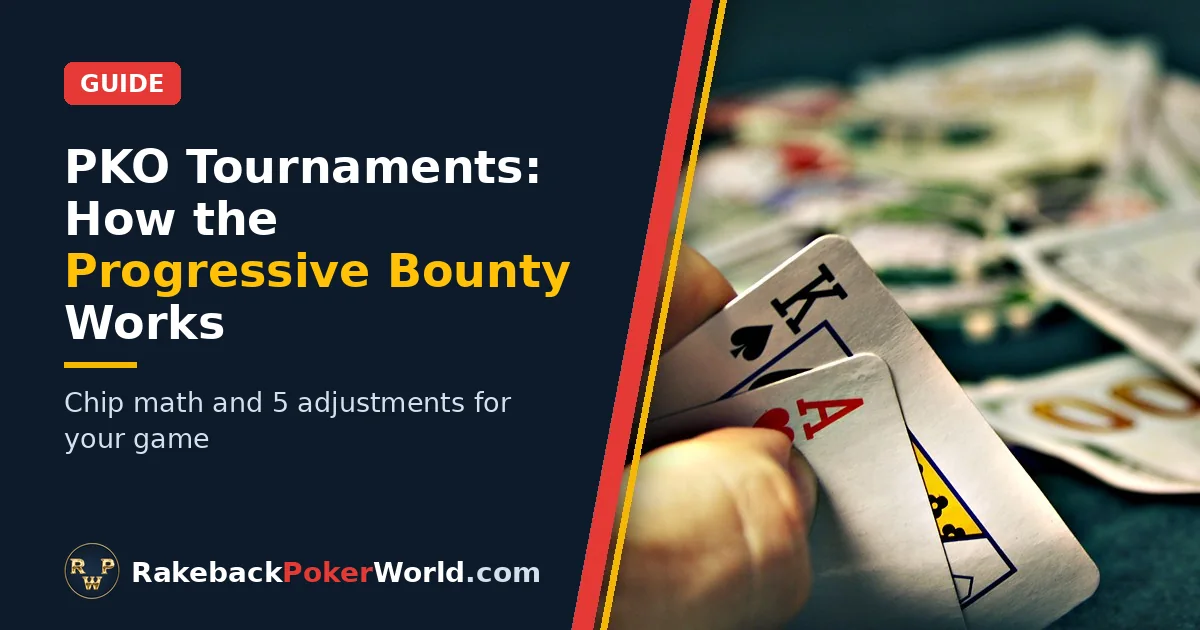
A PKO (progressive knockout) tournament is one where part of the buy-in becomes a reward on each player’s head, the bounty. Whoever eliminates someone collects half of that reward right away, and the other half adds to their own bounty. Because of this, the value of knocking out an opponent grows throughout the tournament and changes your call and all-in math.
Quick summary
- In the most common format, half the buy-in goes to the prize pool and half becomes your bounty.
- When you eliminate someone, you get half their bounty right away; the other half adds to yours.
- Only the player who covers the opponent’s stack wins the bounty. Split pot, split reward.
- The champion keeps their entire bounty, on top of the first-place prize.
- The bounty is worth chips: it lets you call all-ins with weaker hands than you would in a regular tournament.
How the PKO money gets split
In a regular tournament, the whole buy-in (minus the room’s rake) goes into the final prize pool. In a PKO, it’s split into two parts. According to PokerNews, in the standard format, half the buy-in goes to the prize pool and half sits on each player’s head. Some rooms use a different split for specific series, so check the breakdown in the tournament lobby before you register.
The “progressive” part is what happens with every knockout. You don’t collect the full bounty of the player you eliminate: you get half in cash, right away, and the other half adds to the bounty on your own head. The more players you knock out, the more valuable you become to everyone else.
Here’s an example with a $20 PKO (not counting the rake), where $10 goes to the prize pool and $10 becomes your starting bounty:
Stage | You receive right away | Total received so far | Your bounty |
|---|---|---|---|
Start of the tournament | $0 | $0 | $10 |
You eliminate a player with a $10 bounty | $5 | $5 | $15 |
You eliminate another player with a $10 bounty | $5 | $10 | $20 |
You eliminate a player with a $20 bounty | $10 | $20 | $30 |
If someone eliminates you at this point, they get $15 right away and add another $15 to their own bounty. The $20 you’ve already collected stays yours. If you go on to win the tournament, you also take home the $30 from your own bounty.
The rules that confuse beginners
Covering the stack. Only a player with enough chips can score the elimination. If you have 8,000 chips and your opponent has 12,000, an all-in between the two of you won’t eliminate them, and there’s no bounty for you.
Split pot. If two players split the pot in which someone got eliminated, the bounty is split between them too.
More than one elimination in the same hand. Each bounty goes to whoever won the pot in which that player was eliminated. In an all-in with a side pot, you might collect one bounty and miss out on another.
The champion keeps their own bounty. Since no one eliminated them, the winner collects the entire bounty they built up. At the final table, the chip leader’s bounty can be worth more than the pay jumps between some finishing positions.
Bounty in chips: the math that changes decisions
The most common mistake is treating the bounty as a bonus and playing like it’s a regular tournament. PokerNews suggests converting the bounty into chips. In a PKO with a 10,000-chip starting stack, the starting bounty is worth around 5,000 chips, half of the starting stack.
With that in mind, a call that would be bad in a regular tournament can be good in a PKO. In the PokerNews example, an opponent goes all-in with 5,000 chips. Without the bounty, you’d need 44.1% equity (your chance of winning the hand) to call. Once you add the bounty’s 5,000 chips to the pot, the equity you need drops to 31%.
The same math works in reverse. Later in the tournament, with high blinds and big stacks, a small starting bounty is worth little in chips and shouldn’t weigh much in your decision. But the bounty of someone who’s knocked out a lot of players can be worth more than their own stack.
5 adjustments for your PKO tournament game
- Call more all-ins from short stacks you cover. That’s where the bounty matters most: the chip risk is small and the reward is fixed.
- Be careful when you’re short-stacked. When you’re low on chips, opponents will call your all-ins with weaker hands. Bluff shoves become less effective.
- Use a big stack to apply pressure. Covering the table lets you fight for more pots and more bounties. Players who don’t cover you need stronger hands to take you on.
- Register early. According to PokerNews, in a PKO with a $50,000 guarantee, $25,000 is tied up in bounties. Late registrants miss the early knockouts, when there are lots of short stacks at the table.
- Check the bounty before you act. At the major rooms, the value shows up next to each player’s name. Compare it with their stack before you call or go all-in.
To practice the format in bigger series, check out how GGPoker’s Ocean KO and GGPoker’s Bounty Hunters Series work. If any term is unclear, look it up in our poker dictionary.
What this means wherever you play from
PKOs are on the schedule at the major online poker rooms, from daily tournaments with buy-ins of just a few dollars to online series events. The format doesn’t change how withdrawals work: bounty money lands in your account balance just like any other prize. Before you choose where to play, compare the best online poker rooms.
It’s also worth looking at the cost. The room’s rake applies to the tournament buy-in, including the part that becomes the bounty. Find out how that works in our guide to online poker rake, and check out what rakeback is and how it gives you back part of that fee.
Get updates on Telegram
PKO series, room promotions and answers to rakeback questions reach our channel first. Join the RakebackPokerWorld Telegram.
Frequently asked questions
What is a PKO tournament?
PKO stands for progressive knockout. Part of the buy-in goes into the regular prize pool, and part becomes a reward on your head, the bounty. Whoever eliminates you collects half of that reward right away, and the other half adds to their own bounty.
How much do I win when I eliminate a player in a PKO?
At most rooms, half of the eliminated player's bounty lands in your balance right away. The other half increases the reward on your own head, which you only collect in full if you go on to win the tournament.
Do I need to cover my opponent's stack to win the bounty?
Yes. Only the player who eliminates the opponent wins the bounty, and to do that you need to cover their stack, meaning you have the same number of chips or more. If the pot is split, the reward is split too.
What's the difference between PKO and Mystery Bounty?
In a PKO, the value of each bounty is visible at the table and grows with every elimination. In a Mystery Bounty, the value is only drawn after the elimination, starting from a stage of the tournament set by the room.
Sources
- PokerNews: How To Win More From Bounty Tournaments
- PokerNews: Quick Guide to Progressive Knockout Tournaments at PokerStars Play responsibly. 18+ only, and check the legal age where you live.

Who writes this
The RakebackPokerWorld team: professional poker affiliates since 2017, more than 20,000 players helped. We test rooms, payments and rakeback before recommending them.