Poker Account Security: 7 Tips to Protect Your Balance in 2026
Updated on October 18, 2026.
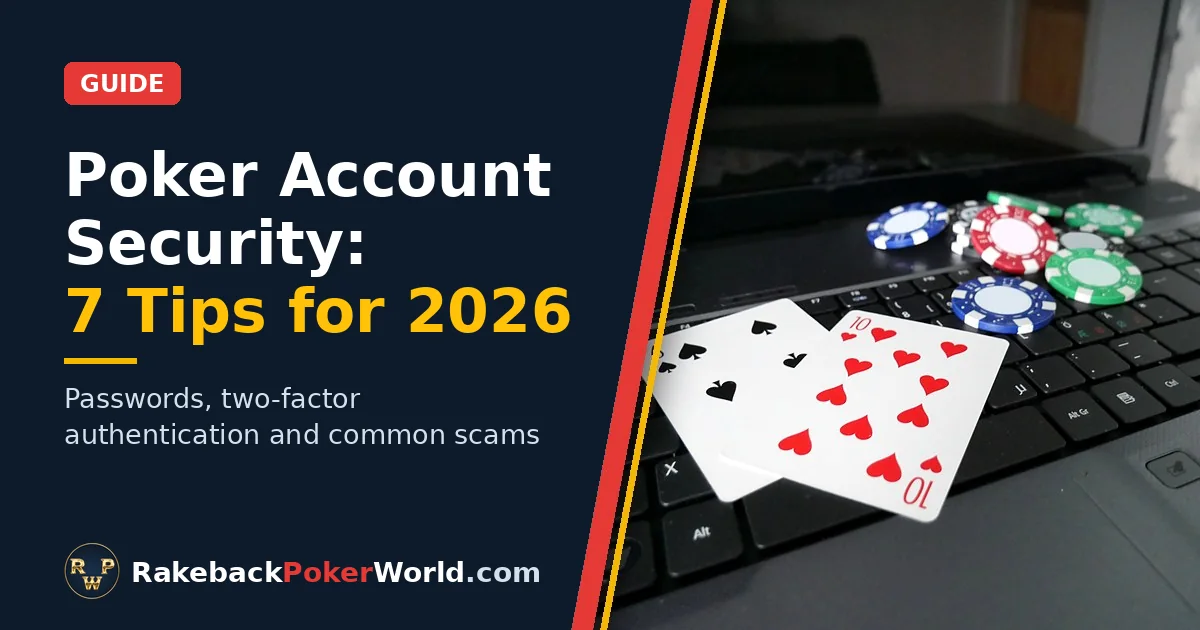
Poker account security comes down to three things: a password you don’t use anywhere else, two-factor authentication turned on, and staying alert to scams that arrive by message. Your account holds real money, and one slip can wipe out your balance in minutes. Here are the 7 things that matter most, and what to do if someone gets into your account.
Quick summary
- Use long, unique passwords for the room and the email address linked to it.
- Turn on two-factor authentication, ideally with an authenticator app.
- No legitimate support team ever asks for your password or verification code.
- Only download software from the official website.
- If your account gets hacked, change your passwords and ask support to block withdrawals.
Why poker accounts become targets
A poker account is, in practice, a wallet. The balance can be withdrawn via e-wallet or crypto, and these payments are fast and hard to reverse. Whoever hacks the account doesn’t even need to withdraw: they can deliberately lose chips at a table to an accomplice — what’s known as chip dumping.
The superuser scandal, which broke between late September and early October 2026, showed that the risk also lives on your computer. According to PokerNews, compromised poker tools gave a cheater access to high-stakes players’ screens, as we explain in our guide to the superuser malware in online poker. Following the scandal, GGPoker banned HUDs and other third-party software and rolled out new security features.
The 7 things that best protect your account
Brazil’s internet security authority, CERT.br, publishes a well-known internet security handbook that sums up the basics: strong, unique passwords for each service, a password manager, two-factor authentication and caution with email.
- A long, unique password. Go for a passphrase with several words. Never reuse a password from another site: when one service’s passwords leak, attackers try the same combination everywhere.
- Protect your email first. Whoever controls your email can reset your poker room password.
- Turn on two-factor authentication. On top of your password, you’ll also need a code from your phone to log in.
- Use the room’s extra security features. According to GGPoker, players there should turn on two-factor authentication, set up a passkey, and use the Fund Password, which protects withdrawals and transfers.
- Only install software from official sources. A HUD, solver or bot offered for free in a messaging group can hide a virus that reads your screen or steals your password.
- Keep your computer up to date. Update your operating system and antivirus, and be wary of remote-access software you didn’t install.
- Your account is personal. Don’t lend, sell or buy an account. Besides the risk of losing your balance, doing so goes against the rooms’ terms of use.
Which two-factor authentication method to choose
Method | How it works | What to watch out for |
|---|---|---|
SMS code | The room sends a code to your phone number. | Better than nothing, but the number can be hijacked in a SIM-swap scam. |
Authenticator app | An app on your phone generates a new code, usually every 30 seconds, and works even offline. | Keep your recovery codes safe. When you switch phones, transfer the authenticator accounts before wiping the old device. |
Passkey | You log in with your device's biometrics or PIN, with no password to type. | Only works on rooms that offer the feature. |
The most common scams against poker players
- Fake support. A profile on Telegram, WhatsApp, Discord or Instagram poses as the room or an agent and asks for your password, verification code, or a “withdrawal release fee.”
- Fake login page. An email or text warns that your account “will be blocked” and leads to a site that looks like the room’s. Type the room’s address yourself or use the official app.
- Miracle software. Pirated tools that promise to show you opponents’ cards or win on their own can hide a virus that steals your account.
- Balance sold off the books. Someone offers to sell room balance outside the platform, takes your payment and disappears. When the scammer is the buyer, it flips: they take your balance and never pay.
- Club with an unknown agent. In club apps, chips pass through the agent. Before you join, read our guide to PPPoker and PokerBros clubs.
The same goes for rakeback: a legitimate program never asks for your password or access to your account.
If your account gets hacked: what to do right away
- On a trusted, virus-free device, change your email password and end any open sessions on that account.
- Change your poker room password and, if the option exists, disconnect other devices.
- Contact support through the official website or app and ask for a temporary block on withdrawals and transfers.
- Gather evidence: screenshots, timestamps, alert emails and receipts.
- If you’ve lost money, file a police report. Many places let you file online.
More ways to protect your money
- Cards and e-wallets. Withdraw only to an account or card in your own name. If you fall for a scam while paying by card or e-wallet, contact your bank or provider right away — chargeback and fraud-protection options depend on your bank and local rules.
- Crypto. Your wallet’s recovery phrase is the key to your money. Keep it off your computer and never share it with anyone. Double-check the address before every transfer, as shown in our guide to using Bitcoin for online poker deposits and withdrawals.
- Choose your room carefully. A room’s reputation and payout record matter as much as its bonus. See how to choose an online poker room and compare the best online poker rooms.
Get the latest news on Telegram
Scam alerts, room changes and promotions go out on our channel. Join the RakebackPokerWorld Telegram and ask your rakeback questions.
Frequently asked questions
How do I turn on two-factor authentication at my poker room?
Look for the security section in your account settings, on the room's website or app. If you're given the choice, pick an authenticator app and keep your recovery codes somewhere safe.
Will poker room support ever ask for my password?
No. No legitimate support team ever asks for your password or verification code. If someone does, even using the room's name and logo, treat it as a scam and contact support through the official website.
Is it safe to use a HUD or other software in online poker?
It depends on the room and where the software comes from. GGPoker, for example, banned third-party software like HUDs in October 2026. On top of that, pirated versions can carry viruses. Only use what the room allows, downloaded from the official website.
What should I do if my poker account gets hacked?
Change your email password and your poker room password, contact support through the official channel, and ask for withdrawals to be blocked. Keep screenshots, and if you've lost money, file a police report.
Can I lend or sell my poker account?
No. Your account is personal, and lending or selling access goes against the rooms' terms of use and can lead to your balance being frozen.
Sources
- CERT.br: Internet Security Handbook — Authentication chapter
- CERT.br: Internet Security Handbook — Scams chapter
- GGPoker: New Security Measures at GGPoker
- PokerNews: Compromised Poker Software on Superuser Scandal: ‘We Are Truly Sorry’
Play responsibly. 18+ only, and check the legal age where you live.

Who writes this
The RakebackPokerWorld team: professional poker affiliates since 2017, more than 20,000 players helped. We test rooms, payments and rakeback before recommending them.